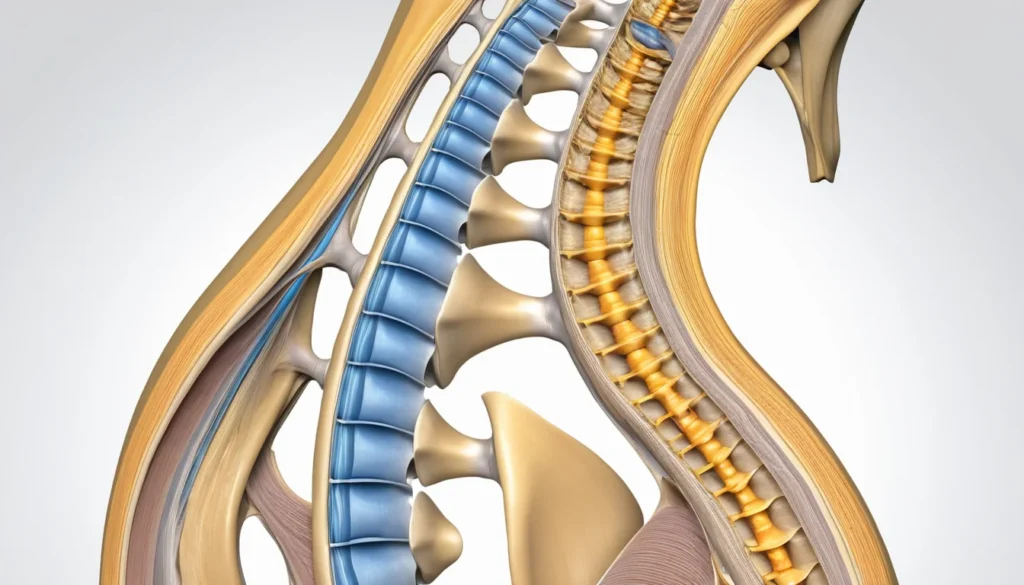
The spinous process is a small but important bony projection found on each vertebra of your spine. These pointed structures form the bumps you can feel when you run your fingers down the centre of your back. Understanding what the spinous process does — and what can go wrong with it — can help you take better care of your spine. This article explains the basics in plain language, so you know what to discuss with your family doctor or healthcare provider.
What Is the Spinous Process?
Your spine is made up of 33 small bones called vertebrae. Each vertebra has several bony extensions called processes, and the spinous process is the one that sticks out toward the back of your body.
If you stand up straight and press gently along the middle of your back, you can feel a row of small bumps. Those bumps are the spinous processes. They run from the base of your skull all the way down to your tailbone.
The term comes from Latin and means “spine-like projection.” In medical settings, doctors and radiologists refer to this structure regularly when reading X-rays, CT scans, or MRI reports. You may also see it written as the acantha in older or specialized medical texts — a Greek term meaning “thorn.”
The Spinous Process and Your Spine Anatomy
Your spine is divided into five regions. Each region has its own set of vertebrae, and the spinous processes in each region have slightly different shapes and angles.
Cervical Spine (Neck Region)
The cervical spine contains seven vertebrae, labelled C1 through C7. The spinous processes here are generally smaller and sometimes forked at the tip. C7 is unique — its spinous process is large and easy to feel at the base of your neck. Doctors often use it as a landmark during physical examinations.
Thoracic Spine (Mid-Back Region)
The thoracic spine has 12 vertebrae (T1–T12), each attached to a pair of ribs. The spinous processes in this region angle sharply downward. As a result, they overlap slightly with the vertebra below, giving the mid-back its distinctive structure.
Lumbar Spine (Lower Back Region)
The lumbar spine has five large vertebrae (L1–L5). These spinous processes are thick, wide, and nearly horizontal. This region carries most of your body’s weight, so the structures here are built to be strong and sturdy.
Sacrum and Coccyx
The sacrum is made of five fused vertebrae, and the coccyx (tailbone) is made of three to five fused vertebrae. Their spinous processes are fused as well, forming a small ridge along the back of the sacrum.
What Does the Spinous Process Do?
The spinous process serves several important functions. It is not just a structural curiosity — it plays an active role in how your body moves and stays stable.
First, muscles and ligaments attach directly to the spinous process. These attachments allow you to bend forward, extend your back, and rotate your torso. Without these anchor points, your back muscles would have no leverage to move your spine efficiently.
Furthermore, the spinous process acts as a protective barrier. It shields the spinal cord and the delicate nerves running through the vertebral canal behind it. Think of it as part of the spine’s natural armour.
In addition, the spinous process limits how far you can bend backward. This prevents hyperextension injuries during everyday movement. Your spine is designed with built-in checks and balances, and the spinous process is part of that system.
For more on how the spine works as a whole, visit Mayo Clinic’s overview of back pain and spinal anatomy.
Common Conditions That Affect the Spinous Process
Several health conditions can involve the spinous process directly. Some are minor, while others require medical attention. Here are the most common ones Canadians may encounter.
Spinous Process Fracture
A fracture of the spinous process can happen after a direct blow to the back, a fall, or a motor vehicle collision. These fractures are sometimes called “clay shoveller’s fractures” when they occur in the lower neck or upper back. They are usually treated with rest and pain management, but your doctor needs to rule out injury to the spinal cord first.
Kissing Spine (Baastrup’s Disease)
This condition occurs when two neighbouring spinous processes rub against each other. It is more common in older adults and in people with degenerative disc disease. The result is localized pain in the mid or lower back, especially when you lean backward. Your doctor may recommend physiotherapy, anti-inflammatory medications, or, in some cases, a corticosteroid injection.
Osteophytes (Bone Spurs)
Over time, the body may grow extra bone around the spinous processes. These growths are called osteophytes or bone spurs. They are often a sign of osteoarthritis or degenerative disc disease. In many cases, bone spurs cause no symptoms at all. However, if they press on nearby nerves, they can cause pain, tingling, or numbness.
Spinal Stenosis
Spinal stenosis refers to a narrowing of the spinal canal. Changes around the spinous process and nearby joints can contribute to this narrowing. The result can be pain, weakness, or numbness in the legs — especially during walking. Health Canada recognizes spinal stenosis as a significant cause of disability in older Canadians.
Infection or Tumour
In rare cases, the spinous process can be affected by infection (osteomyelitis) or a tumour. These conditions are uncommon, but they require prompt medical evaluation. Any persistent, unexplained back pain — especially with fever, weight loss, or night sweats — should be assessed by a doctor right away.
How Doctors Examine and Diagnose Spinous Process Problems
When you visit your family doctor or a walk-in clinic with back pain, the doctor will usually start with a physical examination. They may press along the spinous processes one by one to identify areas of tenderness. This simple test can provide a lot of useful information.
If the doctor suspects a structural problem, they will likely order imaging. An X-ray is the first step and can detect fractures, bone spurs, and alignment issues. A CT scan provides more detail about bone structures. An MRI is the best tool for examining soft tissues, including the spinal cord, discs, and ligaments around the spinous process.
Blood tests are not usually needed for spinous process issues, unless infection or inflammatory arthritis is suspected. Your doctor will guide you through the appropriate steps based on your specific symptoms.
For a deeper look at diagnostic imaging for spine conditions, see Healthline’s guide to spine anatomy and health.
How to Support Your Spinal Health
Taking care of your spine — including the spinous processes — is something you can start doing today. Small, consistent habits make a big difference over time.
Here are some evidence-based tips to support your spinal health:
Stay active: Regular low-impact exercise, such as walking or swimming, strengthens the muscles that support your spine.
Maintain a healthy weight: Extra body weight puts added pressure on the lumbar vertebrae and their spinous processes.
Use good posture: Sit and stand with your spine in a neutral position. Avoid slouching for long periods.
Lift properly: Bend at your knees, not your waist, when picking up heavy objects. Keep the load close to your body.
Eat a calcium-rich diet: Dairy products, leafy greens, and fortified foods help maintain bone density. This protects all your vertebrae, including their spinous processes.
Quit smoking: Smoking reduces blood flow to spinal discs and bones, speeding up degeneration. Talk to your family doctor about free smoking cessation programmes available through your provincial health plan.
See a physiotherapist: A registered physiotherapist can assess your movement patterns and recommend targeted exercises for your back.
These strategies support not just the spinous process, but your entire musculoskeletal system. Prevention is always easier than treatment.
When to See a Doctor
Most back pain is not serious and improves within a few weeks with rest and gentle movement. However, some symptoms need prompt medical attention.
See your family doctor or visit a walk-in clinic if you experience any of the following:
Back pain that does not improve after four to six weeks of home care
Pain that wakes you up at night or is constant and does not ease with rest
Numbness, tingling, or weakness in your arms or legs
Pain following a fall, accident, or direct blow to the back
Fever combined with back pain
Unexplained weight loss alongside back discomfort
Loss of bladder or bowel control — this is a medical emergency; go to your nearest emergency department immediately
In Canada, your first point of contact for non-emergency concerns is your family doctor. If you do not have a family doctor, a walk-in clinic or your provincial telehealth line can help you get assessed quickly. Many provinces also offer physiotherapy coverage through extended health benefits or public programmes — ask your doctor about what is available in your area.
Always consult a qualified healthcare professional before making decisions about your health. This article is for informational purposes only and does not replace personalized medical advice.
Frequently Asked Questions About the Spinous Process
What is the spinous process of a vertebra?
The spinous process is a bony projection that extends from the back of each vertebra in your spine. It serves as an attachment point for muscles and ligaments, and it helps protect the spinal cord. You can feel these structures as the bumps along the centre of your back.
Can a spinous process fracture heal on its own?
Many spinous process fractures do heal with conservative treatment, such as rest and pain relief medication. However, it is essential to see a doctor first to rule out damage to the spinal cord or nearby nerves. Your doctor will decide whether you need imaging and how long recovery should take.
Why does my spinous process hurt when I press on it?
Tenderness over the spinous process can have several causes, including muscle strain, a hairline fracture, or a condition like Baastrup’s disease, where neighbouring processes rub together. Infection or inflammatory arthritis can also cause localized pain in this area. A doctor can examine you and order imaging if needed to find the cause.
What does a prominent spinous process mean?
A prominent spinous process simply means the bony bump is more visible or palpable than usual. This is often a normal variation in body anatomy, particularly in lean individuals. However, if a spinous process suddenly becomes more noticeable after an injury or is painful, it is worth having a doctor evaluate it.
Is spinous process pain covered under provincial health plans in Canada?
Diagnosis and treatment of spinous process conditions — including doctor visits, X-rays, and hospital care — are generally covered under provincial and territorial health plans across Canada. Some treatments, like physiotherapy or massage therapy, may require private or employer-sponsored insurance. Check with your provincial health authority or family doctor for details specific to your province.
How is the spinous process different from the transverse process?
The spinous process projects backward from the centre of each vertebra, forming the bumps you feel down the middle of your back. The transverse processes, on the other hand, project outward to the sides of each vertebra. Both types of processes serve as attachment points for muscles and ligaments, but they are located in different positions on the vertebra.
Key Takeaways
The spinous process is the bony projection at the back of each vertebra that forms the bumps along your spine.
It serves as an anchor for muscles and ligaments, protects the spinal cord, and limits backward bending of the spine.
Common conditions involving the spinous process include fractures, Baastrup’s disease, bone spurs, and spinal stenosis.
Doctors diagnose spinous process problems using physical examination, X-ray, CT scan, or MRI.
You can support your spinal health through regular exercise, good posture, a calcium-rich diet, and avoiding smoking.
See your family doctor or a walk-in clinic if back pain is severe, persistent, or accompanied by numbness, weakness, or fever.
In Canada, most diagnostic and treatment services for spinal conditions are covered under provincial health plans.
Always speak with a qualified healthcare provider for advice tailored to your individual health needs.