Heredity is the process by which parents pass genetic traits down to their children. It explains why you might have your mother’s eyes or your father’s blood type. Understanding heredity can help Canadians make sense of family health patterns and know when to speak with a doctor about inherited conditions.
What Is Heredity? A Simple Explanation
Heredity refers to the transfer of genetic information from one generation to the next. The study of heredity as a science began with Austrian botanist Gregor Mendel in 1866. He discovered the basic laws that govern how traits are inherited.
Every living cell in your body carries a complete set of genetic instructions. These instructions are stored inside structures called chromosomes. Chromosomes determine everything from your hair colour to your risk of certain diseases.
Hereditary diseases occur when a gene changes or mutates. That mutation alters the information the gene carries. As a result, the body may not function as it should. Health Canada recognizes genetic conditions as a key area of public health concern for Canadian families.
How Chromosomes Carry Heredity
The human body is made up of trillions of cells. The nucleus of each cell contains 46 chromosomes arranged in 23 pairs. Scientists group these chromosomes into two main types: autosomes and sex chromosomes.
Autosomes
Autosomes are the 44 non-sex chromosomes found in every human cell. They come in 22 matching pairs. Autosomes carry the genetic instructions for most of your body’s traits and functions.
Each autosome contains thousands of genes. These genes work together to shape how your body grows, develops, and responds to the world around it.
Sex Chromosomes
The remaining two chromosomes determine biological sex. Women typically carry two X chromosomes, written as XX. Men typically carry one X and one Y chromosome, written as XY.
These sex chromosomes do more than determine biological sex. They also carry genes linked to certain inherited conditions, such as haemophilia and colour blindness. This is why some conditions appear more often in males than in females.
DNA: The Molecule Behind Heredity
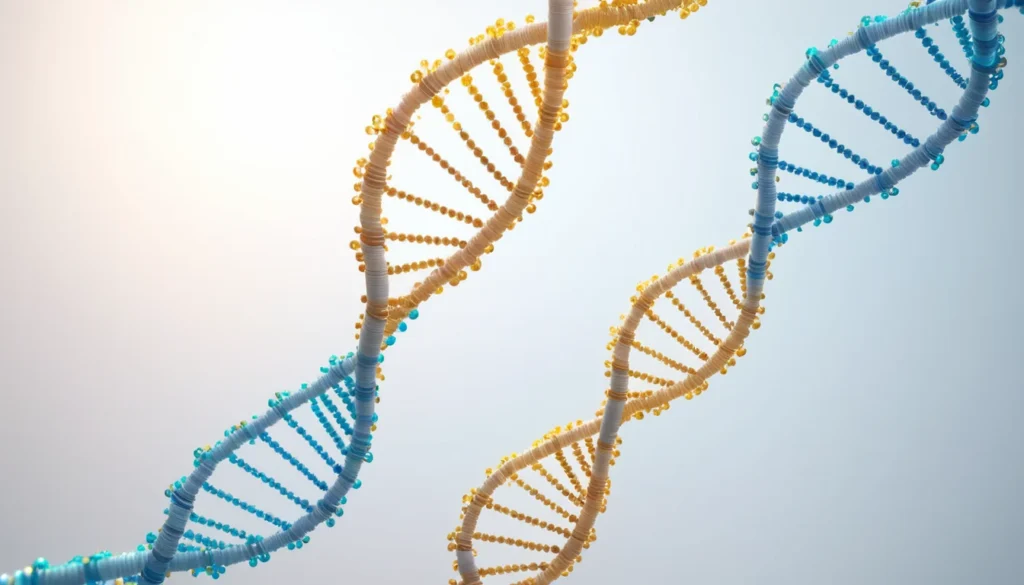
Each chromosome is made up of two twisted strands of DNA. DNA stands for deoxyribonucleic acid. It is the physical carrier of heredity — the molecule that stores all your genetic information.
Along the length of each DNA strand sit specific segments called genes. Each gene carries the instructions for a particular trait. For example, one gene may influence your eye colour, while another may affect how your body processes certain foods.
Each chromosome contains roughly 10,000 genes. Every cell in your body carries the exact same set of genes. This is because all your cells come from the same original cell — the fertilised egg created when a sperm and egg joined at conception.
According to the Mayo Clinic’s overview of genetics and heredity, understanding how DNA works is the first step in understanding why certain health conditions run in families.
Dominant and Recessive Genes: How Traits Are Expressed
Not all genes behave the same way. Heredity follows rules about which gene “wins” when two different versions are present. These rules describe dominant and recessive traits.
Dominant Traits
A dominant trait appears in a child even if only one parent passes it on. For example, dark eye colour is generally a dominant trait. If one parent contributes a gene for dark eyes and the other contributes a gene for light eyes, the child will most likely have dark eyes.
A dominant gene expresses itself even when paired with a different gene on the matching chromosome. It essentially overrides the other version.
Recessive Traits
A recessive trait, however, can only appear when both parents pass on the same recessive gene. Light eye colour is a classic example of a recessive trait. A child with blue eyes received the blue-eye gene from both their mother and their father.
If a person carries only one copy of a recessive gene, they will not show the trait themselves. However, they can still pass that gene on to their children. These people are called carriers.
This distinction matters a great deal in understanding hereditary diseases. Many serious inherited conditions follow a recessive pattern. A child can be born with a condition even when neither parent shows any symptoms.
How Cells Reproduce and Pass On Heredity
Your body constantly makes new cells. It does this through a process called cell division. There are two main types of cell division, and each plays a different role in heredity.
Mitosis: Everyday Cell Division
Most body cells divide through a process called mitosis. In mitosis, one parent cell splits into two identical daughter cells. Each new cell receives a complete and identical copy of the original cell’s chromosomes and genes.
This is how your body repairs tissue, grows, and replaces old cells. The genetic information stays the same throughout your body because mitosis copies it exactly each time.
Meiosis: Creating Reproductive Cells
Reproductive cells — sperm and eggs — form through a different process called meiosis. Meiosis only happens in the ovaries and testes. It produces cells that carry only half the normal amount of genetic material.
Each egg or sperm cell contains 23 chromosomes instead of the usual 46. When a sperm fertilises an egg, the two sets of 23 chromosomes combine. The result is a new cell with a full set of 46 chromosomes — 23 from the mother and 23 from the father.
This combination determines the child’s sex. If the sperm carries a Y chromosome, the child will be XY — a boy. If the sperm carries an X chromosome, the child will be XX — a girl. The egg always contributes an X chromosome.
Autosomal Heredity vs. Sex-Linked Heredity
Genetic traits and hereditary conditions can be passed on through two different types of chromosomes. This leads to two broad categories of heredity.
Autosomal Heredity
Autosomal heredity involves traits carried on the 22 pairs of non-sex chromosomes. These traits pass to children regardless of sex. Both sons and daughters have an equal chance of inheriting an autosomal condition.
Furthermore, autosomal conditions can be either dominant or recessive. Cystic fibrosis, for example, follows an autosomal recessive pattern. Both parents must carry the gene for a child to develop the condition.
Sex-Linked Heredity
Sex-linked heredity involves traits carried on the X or Y chromosome. Because males have only one X chromosome, they are more vulnerable to conditions carried on the X chromosome. Females have two X chromosomes, so a healthy copy on one X can often compensate for a faulty copy on the other.
Haemophilia is one of the most well-known examples of sex-linked heredity. Haemophilia is a condition where blood does not clot properly. It follows an X-linked recessive pattern.
Here is how the inheritance works. If a mother carries the haemophilia gene on one of her X chromosomes (written as X’), and a father has normal chromosomes (X and Y), four possible combinations can occur in their children:
XX (daughter, healthy): She inherits a normal X from each parent. She does not carry the gene.
X’X (daughter, carrier): She inherits the haemophilia gene from her mother but her other X keeps her healthy. She can pass the gene to her children.
XY (son, healthy): He inherits a normal X from his mother and a Y from his father. He is not affected.
X’Y (son, haemophilia): He inherits the haemophilia gene from his mother and a Y from his father. Because he has no second X to compensate, he develops haemophilia.
In short, a daughter who carries the gene (X’X) usually stays healthy because the dominant healthy X overrides the recessive X’. However, a son who inherits X’Y will develop haemophilia because the Y chromosome cannot override the faulty gene on the X. The World Health Organization’s resource on genetic diseases provides further information on how sex-linked conditions are inherited globally.
When to See a Doctor About Hereditary Conditions
If you have a family history of a genetic or hereditary condition, it is worth talking to a healthcare provider. Your family doctor is a great first point of contact. They can review your family health history and refer you to a genetic counsellor if needed.
You may also visit a walk-in clinic if your regular doctor is unavailable. Walk-in clinics across Canada can refer patients for genetic testing through provincial health plans in many cases.
Consider speaking with a doctor if you notice any of the following:
A pattern of the same disease appearing across multiple generations in your family
A family member diagnosed with a known hereditary condition such as cystic fibrosis, haemophilia, or hereditary breast cancer
Plans to start a family and concerns about passing on a genetic condition
Unexplained health symptoms that other family members have also experienced
Genetic counselling is available in most Canadian provinces. A genetic counsellor can explain your risk, discuss testing options, and help you understand what a diagnosis means for your family. Always consult your doctor before making any decisions about genetic testing or treatment.
Frequently Asked Questions About Heredity
What is heredity in simple terms?
Heredity is the biological process by which parents pass genetic traits to their children. It explains why children often look like their parents and why certain health conditions run in families. Heredity works through genes carried on chromosomes inside every cell of the body.
What diseases are passed down through heredity?
Many conditions can be passed through heredity, including cystic fibrosis, haemophilia, sickle cell disease, Huntington’s disease, and some forms of breast and colon cancer. Some conditions require both parents to carry the gene, while others need only one parent to pass it on. Speaking with a genetic counsellor can help you understand your family’s specific risk.
What is the difference between dominant and recessive heredity?
A dominant trait appears in a child even if only one parent passes on the gene. A recessive trait, however, only appears when both parents contribute the same recessive gene. Understanding dominant and recessive heredity helps explain why some traits skip generations while others appear in every generation.
Can heredity be tested before having children?
Yes, genetic testing is available for many hereditary conditions before or during pregnancy. In Canada, your family doctor or obstetrician can refer you for carrier testing or prenatal genetic screening through your provincial health plan. A genetic counsellor can walk you through the options and help you make an informed decision.
Why are some hereditary conditions more common in males?
Some hereditary conditions are linked to the X chromosome. Because males have only one X chromosome, they cannot compensate for a faulty gene on that chromosome the way females often can. As a result, conditions like haemophilia and colour blindness appear far more often in males than in females.
Does heredity determine everything about my health?
Heredity plays an important role in health, but it does not determine everything. Lifestyle factors such as diet, exercise, and environment also have a significant impact on your health outcomes. Even if you carry a gene linked to a hereditary condition, your doctor can help you manage risk through regular screening and healthy habits.
Key Takeaways
Heredity is the process by which genetic traits pass from parents to children through genes and chromosomes.
Human cells contain 46 chromosomes in 23 pairs — 44 autosomes and 2 sex chromosomes.
DNA is the molecule that carries hereditary information. Genes are specific segments of DNA that control particular traits.
Dominant traits appear when passed by just one parent. Recessive traits require both parents to contribute the same gene.
Body cells divide through mitosis, copying chromosomes exactly. Reproductive cells form through meiosis, halving the chromosome count.
Sex-linked conditions like haemophilia are carried on the X chromosome and affect males more often than females.
If hereditary conditions run in your family, speak with your family doctor or visit a walk-in clinic for a referral to genetic counselling.
Always consult a qualified healthcare provider before making decisions about genetic testing or treatment.