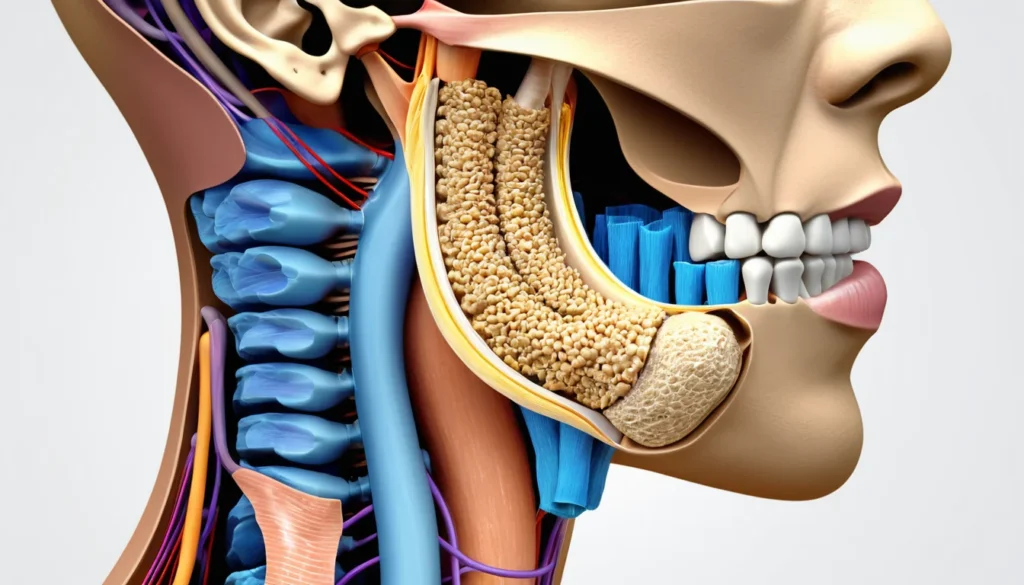
The Adam’s apple is the small, firm bump you can see and feel at the front of your throat. It is made of thyroid cartilage, which is part of the larynx — the structure that helps you breathe, swallow, and speak. Almost everyone has one, though it is more visible in some people than others. This article explains what the Adam’s apple is, how it forms, what it does, and when a change in its size or shape is worth discussing with your family doctor.
What Is the Adam’s Apple?
The Adam’s apple is the popular name for the laryngeal prominence of the thyroid cartilage. The thyroid cartilage is the largest piece of cartilage in the larynx. It wraps around and protects the vocal cords inside your throat.
Cartilage is firm but flexible tissue. It is the same type of tissue that shapes your nose and ears. In the larynx, cartilage gives structure and strength without being as rigid as bone.
The name “Adam’s apple” comes from an old interpretation of the biblical story of Adam and Eve. According to the story, a piece of the forbidden fruit became stuck in Adam’s throat. This is simply a folk tale, however. The prominence has nothing to do with food — it is entirely made of cartilage.
According to Mayo Clinic’s anatomy resources, the larynx sits in the midline of the neck and plays a central role in both breathing and voice production.
Adam’s Apple Anatomy: Understanding the Larynx
To understand the Adam’s apple, it helps to know a little about the larynx. The larynx sits between the base of your tongue and your trachea (windpipe). It is roughly in the middle of the front of your neck.
Key Parts of the Larynx
Thyroid cartilage: The large shield-shaped cartilage that forms the Adam’s apple.
Cricoid cartilage: A ring-shaped cartilage that sits just below the thyroid cartilage.
Epiglottis: A flap that closes over the airway when you swallow, keeping food out of your lungs.
Vocal cords: Two bands of tissue stretched across the larynx that vibrate to produce sound.
Arytenoid cartilages: Small cartilages that help move the vocal cords.
All of these parts work together every time you breathe, speak, or swallow. The thyroid cartilage — your Adam’s apple — acts as the front wall of this system. It keeps the vocal cords safe from injury.
Where Exactly Is It Located?
The Adam’s apple sits in the medial (centre) part of the neck. If you place two fingers gently on the front of your throat and swallow, you will feel it move up and then back down. This movement happens because the larynx naturally rises during swallowing to help direct food away from the airway.
Why Is the Adam’s Apple More Visible in Men?
This is one of the most common questions people ask about the Adam’s apple. The answer comes down to hormones and puberty.
During puberty, testosterone causes the larynx to grow larger in males than in females. As the larynx grows, the angle of the thyroid cartilage changes. In males, this angle becomes sharper — roughly 90 degrees — which pushes the cartilage outward and creates a more visible bump.
In females, the angle is closer to 120 degrees. This means the cartilage does not protrude as much. However, females do have thyroid cartilage and an Adam’s apple. It is simply less noticeable in most cases.
Voice Changes During Puberty
The growth of the larynx is also responsible for the voice changes that happen during puberty. As the larynx gets bigger, the vocal cords get longer. Longer vocal cords vibrate more slowly, which produces a deeper voice.
In males, this change is usually more dramatic. The voice may crack or shift in pitch unpredictably for several months. This is completely normal. As a result, most males settle into a deeper voice by their late teens.
Females also experience some voice deepening during puberty, but the change is usually more subtle. Furthermore, the larynx continues to grow slightly in everyone well into their twenties.
What Does the Adam’s Apple Actually Do?
The Adam’s apple does more than just sit at the front of your throat. It serves several important functions as part of the larynx.
Protecting the Vocal Cords
The thyroid cartilage forms a protective shell around the vocal cords. Without this shield, the delicate vocal cords would be far more vulnerable to injury from external pressure or impact.
Supporting Voice Production
The shape and size of the thyroid cartilage influence the length and tension of the vocal cords. Therefore, the Adam’s apple plays an indirect role in the pitch and quality of your voice. Muscles attached to the thyroid cartilage help adjust vocal cord tension when you speak or sing.
Helping You Breathe and Swallow
The larynx as a whole keeps your airway open when you breathe. When you swallow, muscles pull the larynx upward and forward. This motion, combined with the epiglottis closing over the opening, ensures food and liquid go down the oesophagus rather than into your lungs.
For more detail on how the larynx functions, Healthline’s larynx anatomy guide provides a clear and well-illustrated overview.
Common Questions and Concerns About the Adam’s Apple
Most people pay little attention to their Adam’s apple until something feels different. Here are some common situations that may come up.
Pain or Tenderness in the Throat Area
Mild soreness around the Adam’s apple is often caused by a sore throat, strained vocal cords, or inflammation from a cold or flu. However, persistent pain that does not go away after a week or two deserves attention.
In some cases, pain in this area can be related to conditions such as laryngitis, acid reflux irritating the throat, or, less commonly, injury to the cartilage. Your family doctor can help identify the cause.
A Noticeable Change in Size
If your Adam’s apple seems suddenly larger or asymmetrical, it is worth getting it checked. In most cases, swelling in this area is caused by a nearby lymph node or a thyroid issue rather than the cartilage itself.
The thyroid gland sits just below the Adam’s apple. Thyroid conditions such as goitre (an enlarged thyroid gland) or thyroid nodules can sometimes look or feel like changes in the Adam’s apple area.
Difficulty Swallowing or Breathing
Any difficulty swallowing, a sensation of something stuck in the throat, or any trouble breathing should be assessed by a healthcare provider promptly. These symptoms can have many causes, most of which are treatable. Do not wait to seek care if breathing is affected.
Adam’s Apple and Gender-Affirming Care
For transgender women and non-binary individuals, the visibility of the Adam’s apple can be a source of discomfort. A surgical procedure called a tracheal shave (or chondrolaryngoplasty) can reduce the size of the thyroid cartilage prominence.
This procedure is available in Canada and may be covered under provincial health plans in some provinces as part of gender-affirming care. It is important to speak with a knowledgeable family doctor or specialist who has experience in gender-affirming medicine to explore your options.
When to See a Doctor
Your Adam’s apple is usually nothing to worry about. However, certain signs suggest it is time to visit your family doctor or a walk-in clinic.
A new lump or swelling near the Adam’s apple that lasts more than two weeks.
Persistent hoarseness or a voice change that does not improve after two to three weeks.
Pain when swallowing that is not explained by a cold or sore throat.
Difficulty breathing or a feeling that your airway is narrowed.
Unexplained weight loss combined with any throat symptoms.
A lump that feels hard or is growing over time.
In Canada, your first point of contact should be your family doctor. If you do not have a family doctor, a walk-in clinic can assess you and refer you to a specialist if needed. Most provinces also offer Healthline 811, a free nurse advice line you can call any time to get guidance on whether your symptoms need immediate attention.
Early assessment of any unusual throat symptoms is always a good idea. Most causes turn out to be minor and very treatable. As Health Canada recommends, Canadians should not hesitate to reach out to their healthcare team when something does not feel right.
Please remember: this article provides general health information only. Always consult a qualified healthcare provider for advice about your specific situation.
Frequently Asked Questions About the Adam’s Apple
Do women have an Adam’s apple?
Yes, women do have an Adam’s apple — it is simply less visible than in most men. The Adam’s apple is part of the thyroid cartilage, which everyone has. During puberty, higher testosterone levels cause the cartilage to grow larger and protrude more in males.
Is it normal for the Adam’s apple to move when you swallow?
Yes, this is completely normal. The Adam’s apple moves up and then back down each time you swallow because the entire larynx rises to protect your airway during swallowing. You can feel this movement by placing your fingertips gently on your throat.
Can the Adam’s apple cause pain?
The Adam’s apple itself does not usually cause pain. However, soreness or discomfort around this area can be a sign of laryngitis, a strained voice, acid reflux, or another throat condition. If pain near your Adam’s apple persists for more than a week or two, see your family doctor.
Can the Adam’s apple be surgically reduced?
Yes, a procedure called a tracheal shave or chondrolaryngoplasty can reduce the size of the Adam’s apple. This is sometimes performed as part of gender-affirming care in Canada. Speak with your doctor to find out whether this procedure is covered under your provincial health plan.
What does a sudden change in the Adam’s apple mean?
A sudden or noticeable change in the size or shape of the Adam’s apple area should be checked by a doctor. It may be caused by a swollen lymph node, a thyroid condition, or, rarely, something else that needs treatment. Visit your family doctor or a walk-in clinic for an assessment.
Why does the Adam’s apple grow during puberty?
During puberty, rising testosterone levels cause the larynx to grow. As the larynx gets bigger, the thyroid cartilage — the Adam’s apple — grows too and the angle of the cartilage changes, making it more prominent. This growth also causes the voice to deepen, especially in males.
Key Takeaways
The Adam’s apple is the visible part of the thyroid cartilage, the largest cartilage in the larynx.
Everyone has an Adam’s apple, but it is more noticeable in males due to hormonal changes during puberty.
It protects the vocal cords, helps support voice production, and plays a role in breathing and swallowing.
Most Adam’s apple concerns are harmless, but persistent pain, swelling, or difficulty swallowing or breathing should be assessed by a healthcare provider.
In Canada, your family doctor or a local walk-in clinic is a great first step for any throat-related concern.
Surgical reduction of the Adam’s apple is available in Canada and may be covered under some provincial health plans as part of gender-affirming care.
Always talk to a qualified healthcare professional for advice specific to your health needs.